We were delighted that our recent short publication, Southend, Victorian Town and Resort by Ken Crowe et al was reviewed by Simon Coxall in the most recent Friends of Historic Essex newsletter. We thank Simon and the Friends for permission to reproduce the review on our blog.
Ken Crowe, with I. Yearsley, J. Butler, E. Simpson & J. Williams, The Victoria History of Essex: Southend, Victorian Town and Resort (London, 2025), pp. xi & 131. ISBN 978-1-915249-87-6, £14.99.
Essex has more than its fair share of ancient settlements. Places where good soils and fresh streams like Prittlewell’s ‘babbling brook’ attracted people to put down roots. A few places however, though proud of their ancient past, are a fascinating product of that commercial spirit born of a revolutionary age powered by the steam engine and the pursuit of leisure.
Ken Crowe’s newly published book, the latest in the Victoria County History series, lifts the curtain on the performance that saw Prittlewell grow from a village of 13 houses in 1769 to the burgeoning Victorian resort and borough of Southend in the late 19th century.
Like so much of Essex the villages of Leigh, Eastwood, the Wakerings, Prittlewell and Shoebury have their beginnings as rural settlements. With their churches and a few cottages each made an often scratchy living tilling the land, fishing the waters and farming the oyster beds. Manorial lords whether the Boleyns, the Rich, Earls of Warwick, or the religious estates of Prittlewell Priory reaped the dividends, while a day trip back then might merely involve a visit to the ancient markets of Rochford or Rayleigh.
Then, as revolutionary wars spread across Europe, a coach service stretched out from London to the distant ‘south-end’ of Prittlewell. The 8 hour rickety ride has only some similarities with arterial road queues of later ages. But it was steam that kick-started Southend’s seaside boom.
Who knew the famous Southend pier had its origins in landing stages for the steam packets plying the Thames down from London? Built in 1846, despite the perennial wrangles over its maintenance, by 1895 the pier welcomed 600,000 visitors in the summer season. But it was the arrival of the railway that like some ‘build a city’ computer game would sculpt the Southend we know today.
The genteel folk of the Royal Terrace may have had reservations about the iron horse’s arrival, but cutting the journey time from London to just over an hour ensured the town a prosperous future. Driven by entrepreneurs, Southend’s ‘dry and salubrious air’ attracted crowds of Londoners seeking ‘a popular and delightful place of summer sojourn.’
Early settlers let their rooms to day trippers. Railway excursions with lunch thrown in attracted future buyers of seaside mansions created from the ground-up by Southend’s burgeoning brickworks. Bathing machines, donkey rides, ventriloquists, Italian ice cream and ‘speak your weight’ amusements soon followed. Already the West cliffs beckoned City workers fresh from their commute from the capital, while the flat lands east of Pier Hill found room for the less well-heeled. It was not long before first generation settlers expressed concern about incoming tides of the ‘lower class of excursionists’. By the Edwardian period, Prittlewell’s population had grown from 1,541 to 57,772 in just a hundred years.
Ken’s detailed exploration of the birth of Southend conjures up a town very much on the frontiers of the nascent tourism industry. Here hard-nosed business combined with the frothy jollity of countless Londoners, who, freed by the first ever Bank holidays in 1871, created the resort we know today. As one who trod its streets for several years, Ken’s book brings its Victorian avenues, smugglers inns, its leafy squares, grassy cliffs and bustling streets to life. The Victorian mansions, grand hotels and terraced former boarding houses of a town created almost overnight which Ken guides us through, all of them witnesses to a Victorian revolution no less industrial.
This scholarly work presents an indispensable platform from which the Victorian history buff and family genealogist can construct countless individual stories of hard graft, of hilarity, joy and sorrow.
Reading it, I am reminded of the words of a favourite Essex author – Dorothy L Sayers, who has her hero in The Nine Tailors reminding his colleague in the detection of crime : ‘At Southend you would call it ozone and pay a pound a sniff for it.’
Simon Coxall, FHE Committee Member and landscape archaeologist
We have copies of the book available for sale at a cost per copy of £16 including United Kingdom P&P from VCH Essex, c/o Essex Record, Wharf Road, Chelmsford, CM2 6YT
Cheques should be made payable to Victoria County History of Essex Trust.
Overseas purchasers please contact us for additional postage costs.
On Tuesday 6th January members of the Victoria County History of Essex were very happy to be at the Essex Record Office to support a talk given by Professor Catherine Clarke, Director of the Centre for the History of People, Place and Community at the Institute of Historical Research, which is the home of the national Victoria County History Project.
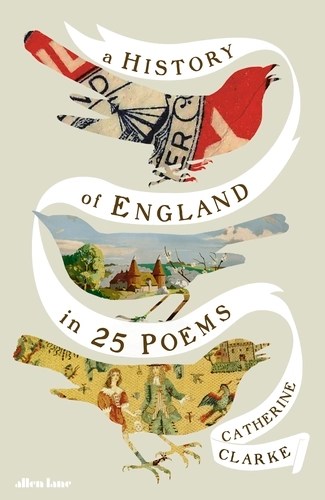
Professor Clarke has recently published a very well-received book, A History of England in 25 Poems, which explores the history of England through 25 poems written between the eighth century and today. Her talk “Maldon, Saxons, Vikings” primarily focussed on the poem in her book with an Essex connection: The Old English poem The Battle of Maldon, which turns a disastrous defeat for Byrthnoth and his men in 991 into a heroic victory for English honour.
The audience were treated to some sections of the poem being read aloud in the original Old English as well as a wonderful explanation of the political undertones of the poem. Clarke argues that poems have the power to open a direct portal between us and moments in the past, and the experiences and emotions of those who lived in the past. On the evidence of this talk, she is the ideal guide to the time travelling potential of poetry and no doubt after this event Chelmsford book shops will have seen a surge in sales of her book!
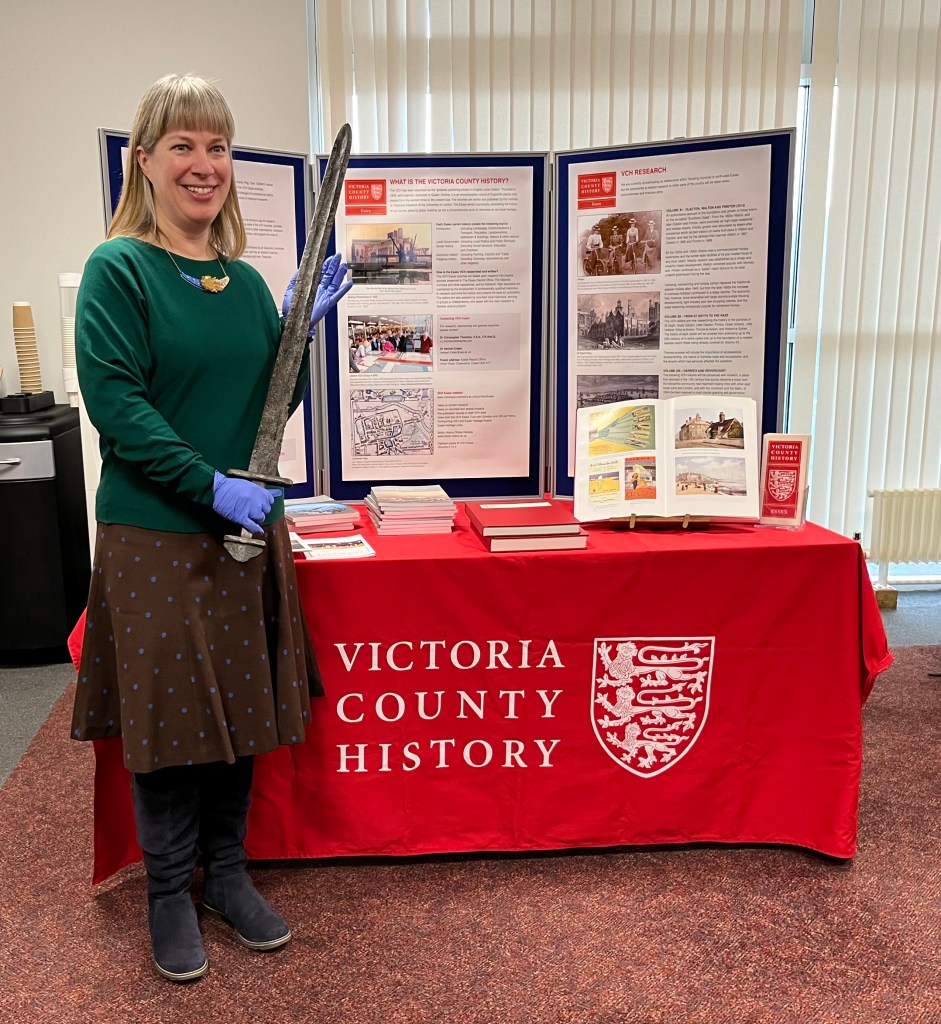
An additional highlight was the presence of the Julie Miller, the curator of the Combined Military Services Museum in Maldon, who had brought with her a tenth-century sword from the museum’s collection, which was found near Maldon. It was an amazing experience for attendees to handle an artefact that might have been used at the Battle of Maldon.
Professor Clarke with the tenth-century sword from the Combined Military Services Museum, Maldon
Thanks to Professor Clarke for coming to Essex and giving the VCH the opportunity to have a display and spread the word about our work and to the Essex Record Office for hosting the event.
Clacton on the Tendring coast is home to one of our three volunteer groups. In this blog, chairman Roger Kennell introduces the group and their current project.
Detail from the Map of the County of Essex 1777 by John Chapman & Peter André
The volunteer members of the Group, founded as a collaboration with the VCH Essex in 2002, have met monthly ever since to research on a range of local history projects. It is a proud fact that the group have always produced positive outcomes from their research, disseminating findings through publications, exhibitions, site information boards or trail leaflets, and generally raising the awareness and understanding of local landscapes and history.
The Group’s current project is titled: ‘Great Clacton: its Church, Hall and Parks. The Legacy of the Bishops of London’
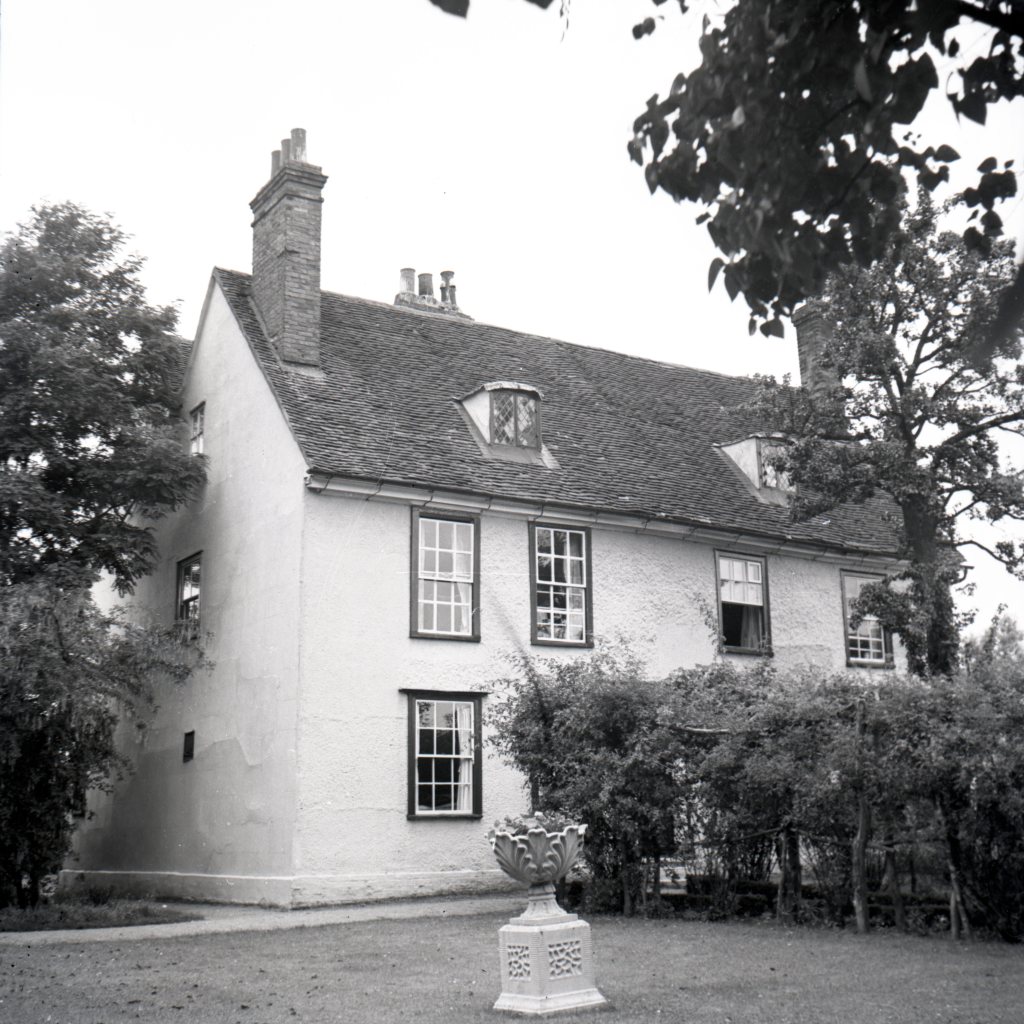
Great Clacton Hall in 1940. Photo credit, the late Kenneth Walker.
Our two-hour long meetings, which begin with a welcome tea of coffee, are held at Tendring Village Hall, and usually consist of a Power Point presentation on an aspect of the project followed by a discussion and planning as necessary.
These meetings can be flexible. At our October meeting the opportunity arose to welcome Neil Wiffen to provide his talk on ‘Towering Defences’, how a defence system against a Napoleonic invasion developed along the Essex and Suffolk shore.
The following month of November, we returned to our Great Clacton project. The Domesday Survey includes a single entry for Clachintuna, there then being no division into Great and Little Clacton. Listed is the following: ‘now 1 mill’. Hitherto, no location for this mill has been found, but during our session two probable places were identified, both being potential tide mill sites. One lay on the coast at Wash Lane with the Reed Land Pool, and the other, perhaps with more evidence including field names and track ways, being on the Holland River near Clacton Park.
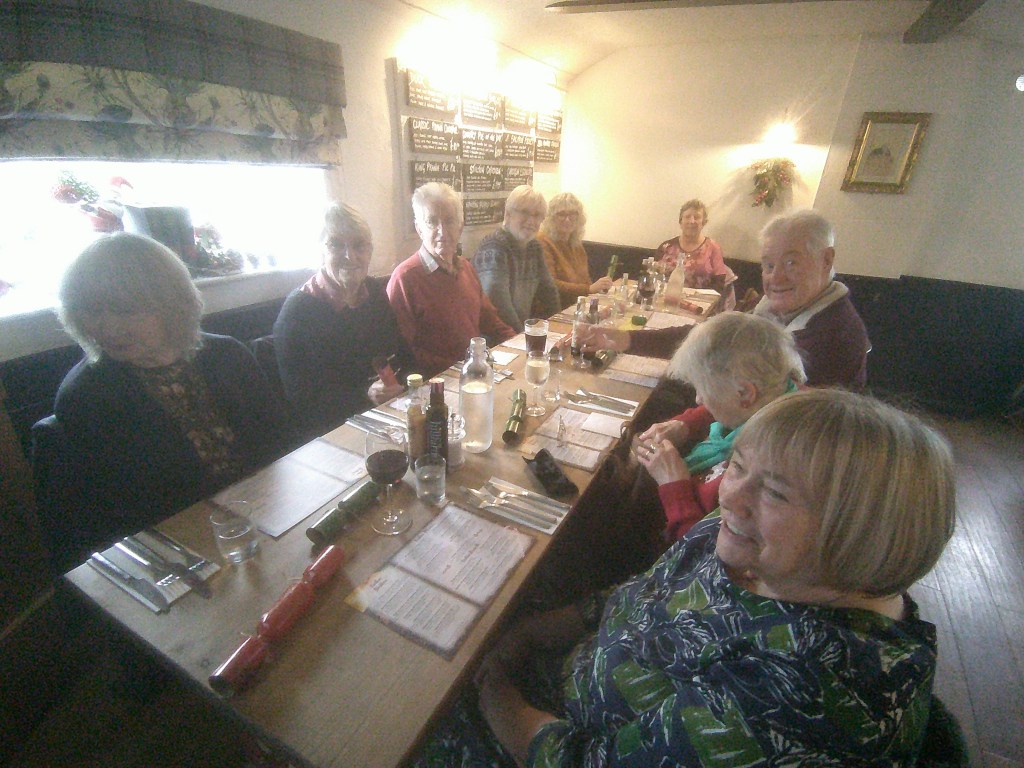
Members of the Clacton VCH group about to enjoy a convivial Christmas lunch
At the December meeting, being a festive time and one for reflection, an illustrated glance back at some of our previous projects was enjoyed. This was especially helpful to some of our more recent members to highlight our range of research and record of positive project outcomes.
We are now underway with planning the New Year, 2026. January will see a meeting to examine and interpret the recent report on a resistivity survey of the churchyard of the parish church of Saint John. This report has the potential to increase our understanding of the manorial complex of the bishop’s of London, including their ‘stately house’.
A postcard from before 1914 showing the 12th century parish church of Saint John the Baptist, Great Clacton.
The Clacton VCH Group intends to provide a further blog update as our research continues.
Trustee Ben Cowell, Director General of Historic Houses, has provided this report about our annual symposium, which took place at the Galleywood Heritage Centre on Saturday 4 October 2025.
The Essex VCH Trust was very grateful to all who joined in our 2025 study day, held at the Galleywood Heritage Centre on Saturday 4 October. Our theme for the day was ‘Crime and Society in Essex’, and we were treated to four exceptional talks covering a range of periods and perspectives.
Simon Coxall began proceedings with an intriguing talk on the ‘Curious Quest for Quamstowe’, exploring judicial execution in medieval Essex. The term ‘Quamstowe’ referred to the gallows that served as the sites of execution for many manors and parishes. Simon had located over fifty such sites across the county, meaning that they might have been shared between several townships or settlements. For this reason, they were often located on administrative boundaries (which explains why they were so often found on hilltops), as well as at the intersection of major highways (often former Roman roads). The most famous gallows site in English history was Tyburn, located beyond the outer edge of Westminster and the city of London and at the intersection of two important Roman roads (Watling Street, and the road that is now Oxford Street). More research was needed to excavate more of the history of gallows sites in Essex, now entirely lost to posterity but nonetheless surviving as traces in field names and on maps.
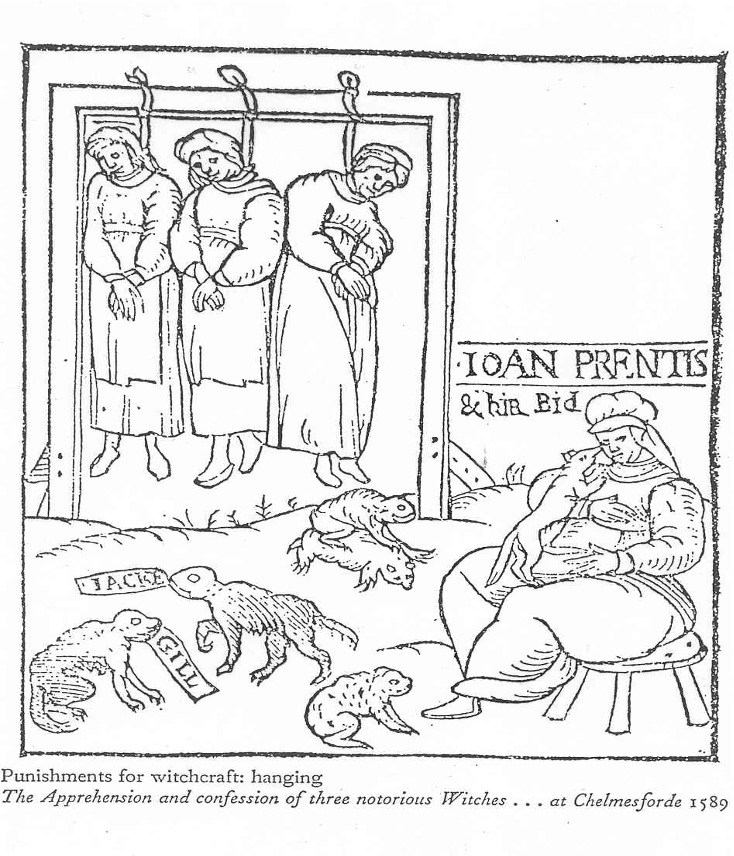
Next, Alison Rowlands (University of Essex) treated us to a bravura account of the witchcraft trials in Essex of the 16th and 17th centuries. Her principal focus was the surge in witchcraft convictions of the 1570s and 1580s, a prelude to the more famous spike in prosecutions that occurred in the 1640s thanks to Matthew Hopkins. Alison directed her attention away from Hopkins and towards the 16th-century convictions, asking why they grew in such number at this time. Answers were variously associated with factors such as harvest failures, misogyny, and the propensity of puritan elements to be especially damning of those believed to be acting in association with the devil and his familiars. Some men were convicted of ‘magic murders’, but witchcraft was predominantly a charge levelled at women, often those who were older and living alone. Essex was noticeable for the volume of its witchcraft convictions, and Alison convinced the room that much more historical research was needed on this most fascinating (as well as disturbing) of topics in English social history.
A full house at the Galleywood Heritage Centre
The conversation shifted another gear with our next speaker, John Walter (Professor Emeritus, University of Essex). John gave a masterful account of the moral economy of food protests, using examples from Essex in the 17th and 18th centuries. Claims of the ‘people’ often paralleled the viewpoint of the government, at least when it came to attitudes towards ‘Dunkirkers’ and other elements in the political economy of grain. The law did not recognise assemblies of women protesting against food prices as criminal, which gave legal cover for women in Maldon in 1629 to invade a ship sitting in the quay with a cargo of grain, bound for the continent. By demanding for their bonnets and the folds in their skirts to be filled with grain, these women were participating in a choreographed expression of moral attitudes towards the free market. They did not regard themselves necessarily as protestors, so much as providing a corrective to the worst excesses of capitalism at times of extreme hunger. Nevertheless their leader, ‘Captain’ Ann Carter, was eventually hung for inciting riotous behaviour.
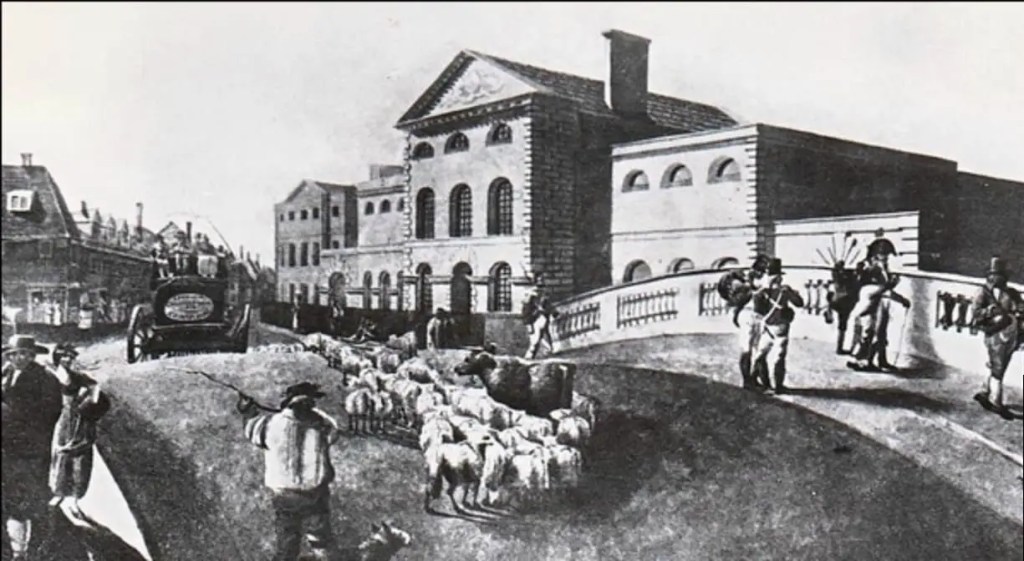
The old county gaol in Moulsham (demolished in 1859)
Finally, Jane Pearson (University of Essex) gave us an excellent overview of the workings of crime and punishment in Essex in the 18th and early 19th centuries. Using the example of a set of travelling performers and quack doctors (mountebanks) in Epping in 1791, she invited us to speculate on the criminality or otherwise of these sorts of gatherings. The crime at stake here was not necessarily that of performing without a licence, so much as of running a lottery (open-air gambling games). Several of the protagonists ended up spending time in Chelmsford goal. This itself was an indication of changing attitudes towards crime, with incarceration reinvented in the 19th century as first and foremost a means of punishment. Although prisons at this time were not pleasant places, it at least meant that judges were making less recourse to the gallows – which had by now ceased to be the ubiquitous features in the landscape that Simon Coxall had described earlier in the day.
The four talks sat well together, and several themes emerged. One was the exceptionalism of Essex when it came to particular crimes, such as claims of witchcraft or some types of food riot. Another theme was the role of women, both as the victims of crime but also as agents of protest and extra-judicial action. We extend our thanks to all our speakers, as well as to our audience for their intriguing questions and comments throughout the day.
To mark the upload of a draft chapter on Harwich 1919-1939, VCH Essex researcher Dr Andrew Senter has written a post about the growth of motor traffic, and attempts to accommodate it, as Harwich and Dovercourt went through a period of considerable modernisation between the wars.
The increased use of the roads by private motor vehicles was notable from the early 1920s and accordingly the police were required to attend to traffic offences mainly involving speeding. In 1920 Harwich Borough Council resolved to apply for an order to restrict the speed limit for charabancs and ‘heavy’ motor cars to six miles per hour at a time when the national speed limit was 20 mph. An especially dangerous section of road was the junction of Garland Road and Parkeston Main Road (officially renamed Station Road in 1931) in Parkeston, which was the responsibility of Essex County Council. A sign had to be erected, probably in the mid 1920s, but this did not appear to deter speeding. The borough’s first road census was conducted in 1925 as the council became concerned about the volume of traffic. Various road-widening programmes were carried out at around this time especially along Main Road in Dovercourt.
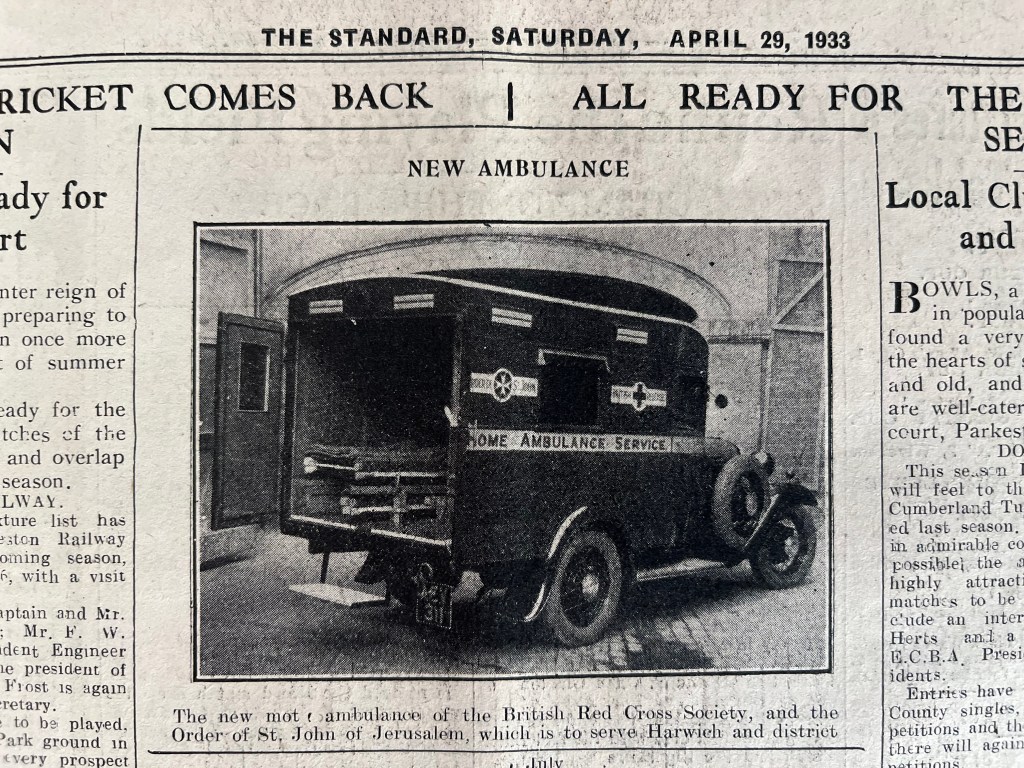
The transition from horse-drawn vehicles to mainly motorised transport was evident among commercial and public service vehicles. For example, the local Co-operative Society bought several vans and lorries in the interwar period including in 1931 a lorry to replace the horses previously used on its coal rounds. From 1921 refuse collection in Harwich borough was carried out by an electric vehicle which replaced the horses and carts. The local fire brigade bought a new motorised fire engine in 1925 leading to the selling of the horses and equipment used with the previous steam engine. The council had use of the British Red Cross Society motor ambulance based in Dovercourt in the interwar period; in 1932 it granted £100 to the society towards the cost of a new one. The council’s own horse-drawn ambulance was only finally destroyed in 1938.
The provision of public transport increased greatly in this period. The first buses commenced running to and from Colchester in 1921. Other local services were provided by charabancs, motor buses, taxis known as hackney carriages and still in 1924 three horse-drawn vehicles. In 1927 the Silver Queen Motor Omnibus Co. was granted a monopoly on local bus services and the National Omnibus & Transport Co. Ltd (both companies were subsequently absorbed into the Eastern National Omnibus Co. Ltd) was licensed to extend the Colchester-Harwich service to all year round. Dovercourt’s longest-established business, now known as Starlings Taxis, was started by Robert H. Starling by 1877 and continued by his son George E. Starling. In the 1920s they ran charabancs and taxis, with the company becoming G. E. Starling and Sons after 1928 when George’s sons Robert and Oliver continued the business.
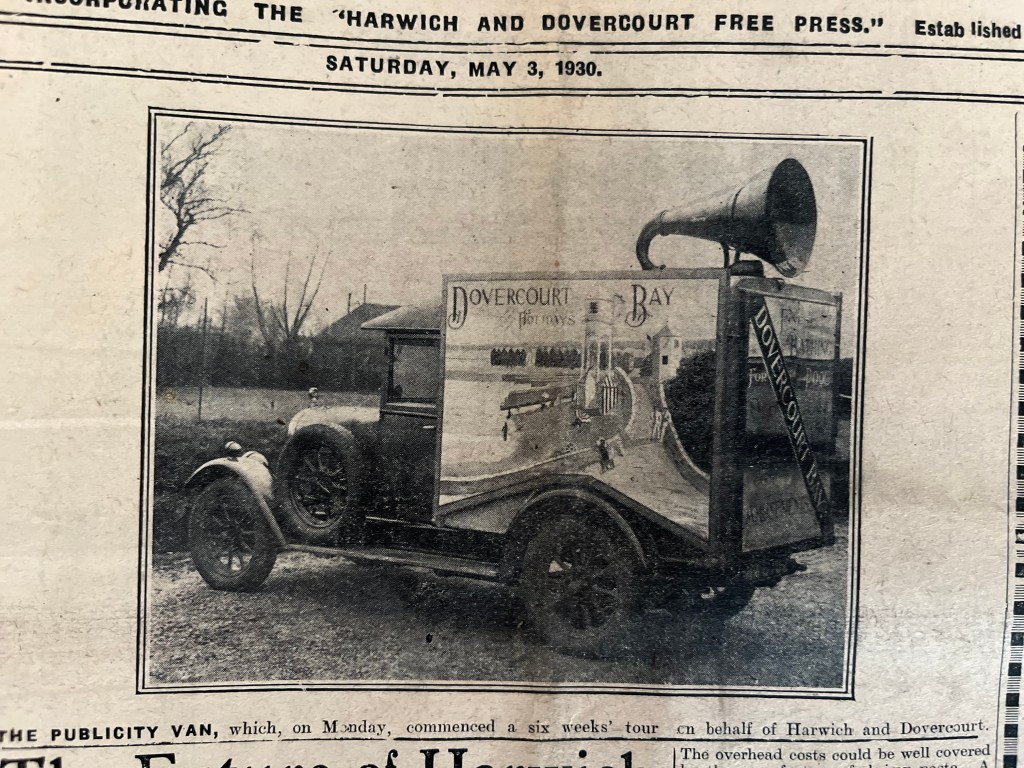
The 1930s saw much wider areas covered by public transport: in 1930 George Ewer & Co. Ltd inaugurated a bus service between London and Harwich. Dovercourt’s role as a seaside resort led to greatly increased advertising. The publicity van belonging to the local MP, John Pybus, toured the eastern region in both 1930 and 1931. The tour appears to have been successful as bus excursions ran from Wickham Market two years later. Attracting visitors from the Midlands was later adopted as a policy by the council resulting in Allenways Ltd, of Birmingham running a coach service to Harwich, Dovercourt and Parkeston in 1937. In the same year licences were also granted to the Eastern National Omnibus Co. Ltd by the Traffic Commissioners for the Eastern Area to run two new coach services from Bedford and Luton to Dovercourt.
A free public car park was opened in late 1937 in Station Road, Dovercourt, apparently on land that had been purchased by the council in late 1935 or early 1936. Dovercourt became increasingly congested by the mid 1930s. Traffic lights were installed at the junction of High Street and Kingsway in 1937. Increased road traffic in general can be seen in the census carried out during the holiday season in August 1938. In a one-week period 35,345 vehicles passed along Main Road at All Saints’ church, Upper Dovercourt, representing a significant increase on the 1935 figure (31,143).
The trust makes drafts available to share research in advance of publication. Comments on draft histories are welcome, so feel free to get in touch via our contact form!
Join us for an exciting in-person afternoon event on Saturday 4th October at the Galleywood Heritage Centre, exploring research about crime and society in Anglo-Saxon, early-modern and eighteenth-century Essex. There will be a series of four fascinating talks with a mid-afternoon break for tea and cake (included in the £15 ticket price), a booksale and raffle.
In this blog, Herbert Eiden uncovers the tricky relations between William Innes and his parishioners in Harwich.
Shortly after Thomas Drax, the incumbent vicar of Dovercourt cum Harwich, died in January 1619, the bishop of London presented William Innes on 18th March 1619 as perpetual vicar to the parish. Since the dissolution of Colne Priory, the advowson (the right to nominate a cleric to a vacant benefice) for All Saints, Dovercourt, and the chapel of St Nicholas in Harwich rested with the crown. We do not know if James I took a personal interest in the appointment of Innes or if he delegated this task to the bishop. We also do not know where William Innes came from and where he conducted his studies. Although he is listed in the bishop’s register as having a MA (Magister Artium) his name cannot be found in the alumni registers of Oxford or Cambridge.
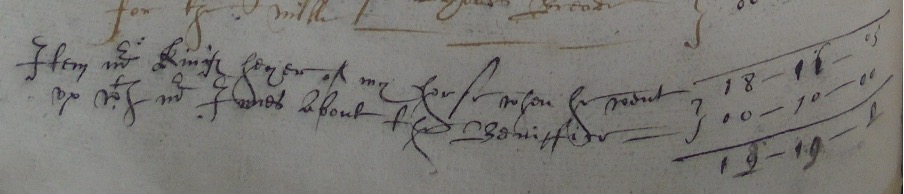
Innes is mentioned for the first time in Harwich records in a list of churchwarden expenses for the year 1618: William King, who was mayor of Harwich the previous year, claimed 10s for horse hire “when he went up with Mr Innes for the benefice”. [Church Book, Harwich Town Archive 98/1, f. 280v]. It is the final entry for the year and given that the year in England began on Lady Day (25th March) the expenses occurred probably in February or early March 1619.
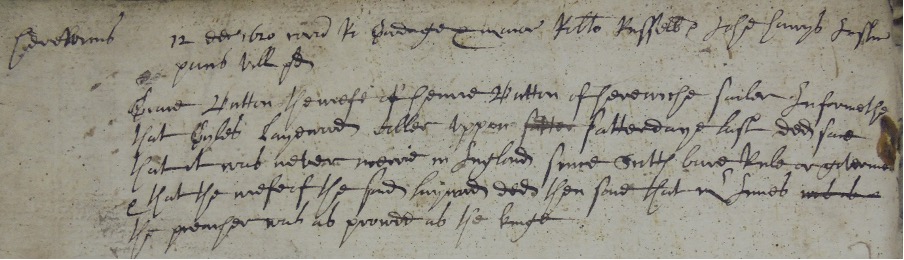
Only a short while into his incumbency, a court case reveals Innes’ unpopularity with some of his parishioners. The Court of Pleas, the lowest court in Harwich which dealt with minor suits of debt, theft, trespass, slander and other petty offences, heard on the 12th December 1620 from Grace Button, wife of Henry Button, sailor, “that Giles Haywood, cobbler, upon Saturday last did say that it was never merry in England since Scots bare rule or governed and that the wife of the said Haywood did then say that Mr Innes, the preacher, was as proud as the king” [Court of Pleas, HTA 98/2 f.182v; spelling modernised].
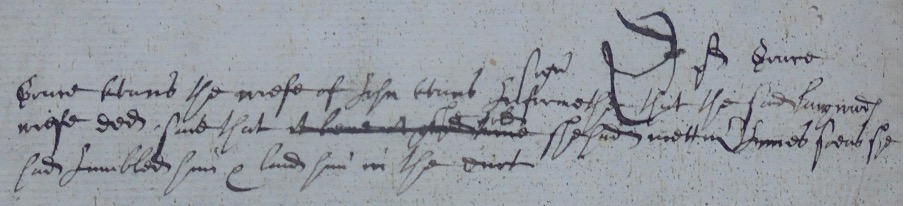
A second witness, Grace Evans, wife of John Evans, testified that “the said Haywood’s wife did say that she had met Mr Innes; says she had humbled him and had him in the dirt”.
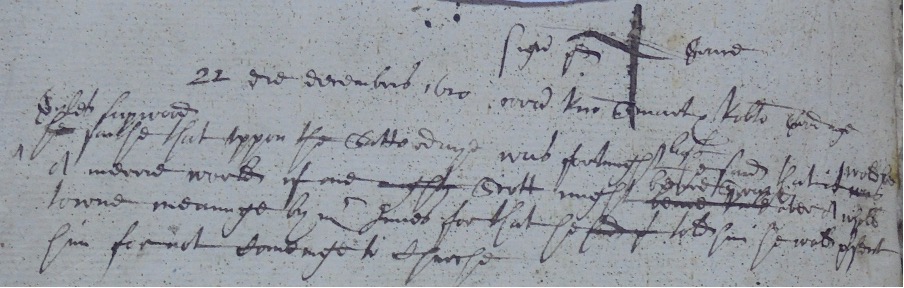
Finally, ten days later Giles Haywood confirmed that he spoken to the vicar “on Saturday a fortnight ago” and that he said “it would be a merry world if one Scot might become sovereign over an English town, meaning by Mr Innes for that he told him he would present him for not coming to church”.
Although the meaning of these three statements is not entirely clear it seems Grace Button alleged that Giles Haywood had insulted the king by declaring that the times of ‘Merry England’ were over since James I, a Scot, had come to the throne, and that Haywood’s wife then doubled down and called the vicar as haughty and arrogant (‘proud’) as the king. Less detail about what was said is given by the second witness, Grace Evans, but she seems to corroborate that Haywood’s wife humiliated Mr Innes.
Haywood’s deposition gives a different slant to the story when he, probably sarcastically, commented on the occasion of meeting the vicar that it must be a joyful world if a Scot became the ruler of an English town. This was directed at Mr Innes, because the vicar had notified him that he would report him for not attending church. In this reading the insult is not explicitly directed against the king. Instead, it implies that William Innes was Scottish and Haywood’s derogatory remark was an ethnic slur, which, however, was also a dig at the king.
The toponymic surname ‘Innes’ originates from Moray in Scotland. Confirmation of his Scottish origins comes from Burke’s Peerage which lists William as one of seven sons of the Alexander Innes of Cotts and Leuchars who was the bailiff of Spynie. His royalist family background probably explains his presentation to Dovercourt cum Harwich vicarage. It also might explain why he cannot be found in the Cambridge and Oxford registers because he quite likely had a degree from a Scottish university.
Unfortunately, nothing is known about the outcome of the case. However, William Innes and his Harwich parishioners – he seems to have been getting on with his congregation in Dovercourt – were at loggerheads on several occasions during the coming decade. It seems likely that a naval and mercantile town, in close relationship with the Low Countries would have been more Puritan in outlook than the neighbouring rural parish. Innes quarrels with Harwich Puritans culminated in a case before the supreme ecclesiastical Court of High Commission in 1629–1631, in which even the king got involved at one stage. But this is something you will have to wait to read in the Harwich and Dovercourt Red Book.
As we continue planning for this year’s annual symposium at the Galleywood Heritage Centre on Saturday 4th October, a look back at last year’s event!
We were grateful to three of our trustees, Lord Petre, Dr Amanda Flather and Sir Graham Hart for giving talks, alongside our long-term friend the architectural historian Dr James Bettley. In this blog chairman Ken Crowe provides an overview of each of their talks.
Lord Petre: The Catholic Experience in Essex, 1535–1829
It was clear that throughout this three-hundred-year period, Catholics of great skill and abilities were able to rise to high office. William Petre, one of the king’s commissioners for the Dissolution of the monasteries, continued to hold high office into Elizabeth’s reign. John explained that, despite the high price paid by some, it was really only after the excommunication of Elizabeth by Pope Pius V that Catholics in general began to suffer from a series of draconian laws. But even then, when Catholic priests were regarded as enemies of the state, others could rise to the top. John cited the example of William Petre’s son, John, who was commander of the Essex Militia at Elizabeth’s Armada speech at Tilbury.
The practise of Catholicism was banned, and anybody not attending (Protestant) church was to be summonsed, such as the Ingatestone widow and her daughter who were fined £120 in 1621. The second Lord Petre’s sons were arrested in 1627 for attempting to go abroad to attend a Catholic school. Catholics were also excluded from the professions or dealing in property. By an Act of 1700 Catholics were not allowed to go more than 5 miles from their usual place of abode, or to own a horse worth more than £5!
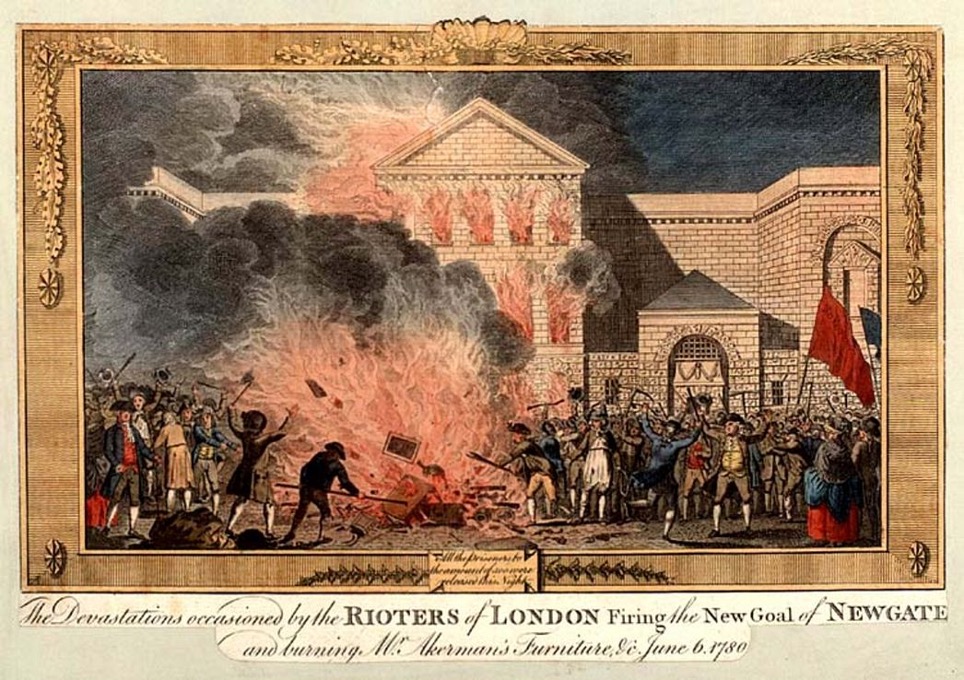
How did Catholic families in Essex fare? The 4th Lord Petre, living during the Commonwealth, was immediately suspected of being a Royalist, and by 1659 his liabilities exceeded his income by 20 times! Some others kept a very low profile and went ‘underground’, the most obvious example being the so-called priests’ hiding places. The Waldegrave family remained staunchly Catholic until 1721 when James Waldegrave took the Oath of Supremacy and found himself created Earl Waldegrave. But generally, with far fewer Catholic families in Essex (in 1634 only 20 of the 280 arms-bearing families) anti-Catholic legislation was only half-heartedly enforced. During the 18th century anti-Catholic rules were being relaxed; some Catholics entered the professions and, despite the flare-up of anti-Catholic riots in James II’s reign such as the Gordon riots, Catholicism was not seen any more as a threat to the state. Eventually, senior lay Catholics under the chairmanship of the 9th Lord Petre promoted a resettlement of the law, leading to the Act of Toleration and, eventually in 1829, the Emancipation Act.
Dr Amanda Flather, Women and the Reformation in Essex: Campaigns against religious change in Essex in the 1630s and 1640s.
Using evidence from church court records, together with diaries and wills, her paper focused on women’s involvement in local conflicts over religion in the decades before the Civil War. The 1630s was characterised by deep divisions within the church and state; the marriage of Charles I to a Catholic queen was seen as a threat to the Protestant nation, only exacerbated by the introduction by Archbishop William Laud of liturgical practices that placed a renewed emphasis on ceremony and sacrament. These changes were seen by zealous Protestants as a challenge to the customary order of worship to a dangerous degree, and Amanda examined how often women were involved in campaigns against Laudian policy.
Women, particularly married women, played a significant role in church services and parish life, including baptisms, as midwives, churching, funerals, church cleaning and washing of vestments, and they wielded considerable informal influence over the politics of the parish especially relating to moral issues. Women protested against Laudian changes to the liturgy, in particular over the conduct and form of ceremonies with which they were most closely associated such as baptism, burial and churching, which zealous Protestants regarded as ‘dangerously superstitious.’ Examples of resistance included refusal to wear the veil or to go to the altar rail to be churched. Tabitha Sharp of Sandon refused to be churched at all.
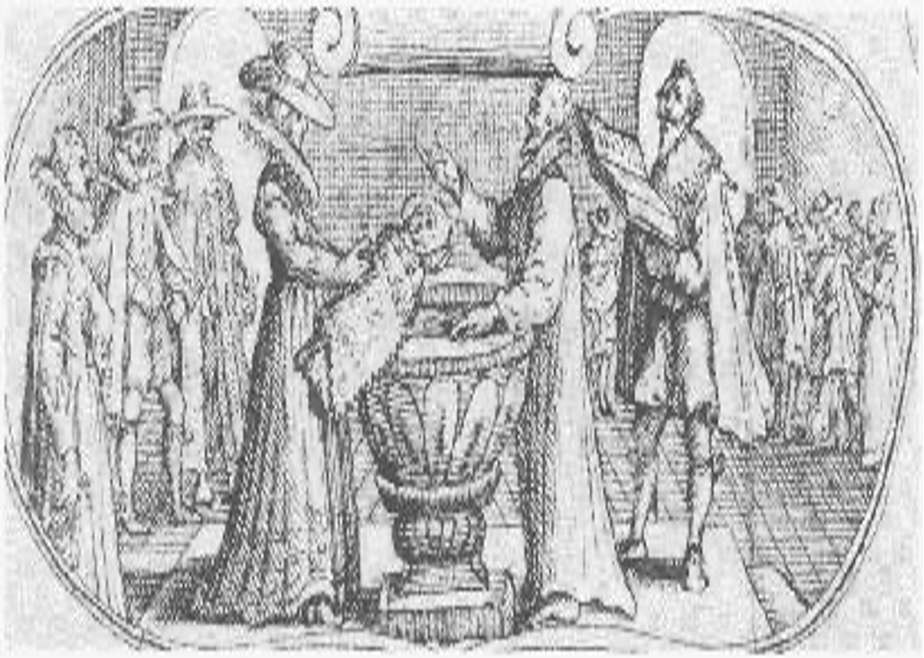
The Baptismal Party Around the Font, ‘Th 1 Christians jewell [fit] to adorn the hearte and decke the house of every Protestant ‘, copper engraving taken out of, St Mary Queris Church during the lectureship of Doctor Sutton, 1624
Clergymen were criticised by female parishioners for poor preaching and some women participated in campaigns by Parliament to root out ‘scandalous’ ministers. [See Graham’s talk, below]. Moral order was the aspect of parish politics in which female influence was dominant. The evidence suggests that married women of ‘middling’ status in particular were engaged in direct action to rescue their churches from what they saw as the clutches of popery. It is in the responses to Laudianism that allow us to trace female voices and opinions that are so rarely heard.
Sir Graham Hart : ‘Scandalous Ministers’? Parliament’s Persecution of the Clergy of Essex, 1644.
In 1644 the Civil War was still in the balance. Parliament controlled London, Essex and neighbouring counties, while the King’s forces controlled much of the North and West of England. Religion lay at the root of many of Parliament’s grievances against Charles I. In the 1630s he had supported Archbishop Laud’s hostility to Puritans and policies on ceremony in worship: Parliament was now reversing those policies and reforming the Church.
In January 1644 Parliament ordered the Earl of Manchester, the General of its forces in the Eastern Counties, to carry out a purge of the clergy within his area, which included Essex. The aim was to remove ‘scandalous’ ministers from the Church and replace them by ‘godly preaching ministers’. Manchester appointed committees in each county to hear complaints about the clergy, who could be ejected if judged unfit, and have their income from the parish confiscated.This opportunity for discontented parishioners to complain resulted in 39 ministers being referred to the Essex committees for scandalous ministers.
How did the parishioners interpret their remit to identify ‘scandalous’ ministers? The charges they brought fall into four groups. Seven of the ministers were pluralists who were accused of being absent from and neglecting their parish. A second group, more numerous, were accused of immorality. 19 ministers faced charges relating to drinking. Three or four of them appear to have had a serious drink problem: Simon Lynch, Rector of Runwell, even turned up at his hearing with the committee under the influence. Five ministers were accused of sexual offences, usually by women who claimed to be victims. Other behaviour unacceptable to some parishioners included mild swearing (‘by my faith and troth’) and playing cards.
A third group of charges accused ministers of having, in the 1630s, complied with instructions from the Bishop about religious matters, such as requiring parishioners to kneel at the rail before the altar to receive communion, or to bow at the name of Jesus. Such practices reeked, to puritans, of superstition, idolatry and popery.
A fourth set of charges related to acts which amounted to openly supporting the King in his conflict with Parliament. Parliament was particularly concerned about clergy who spoke against it, for example to persuade people to refuse to take the various oaths supporting its policies which Parliament tried to impose on them.
In summary a few of our Essex ‘scandalous’ ministers were, if the charges are accepted as truthful, unworthy to serve as parish ministers. But the great majority were not men of bad character. Instead, they seem to have been respectable ministers who were accused of failing to support Parliament in its conflict with the King, and of being on the wrong side in the puritans’ long struggle against the leadership of the Church of England.
Dr James Bettley: The Architectural Consequences of the Reformation in Essex
The Reformation was a turning point in the history of the country’s buildings just as it was for religious worship. The Dissolution of the Monasteries under Henry VIII, the suppression of chantries and guilds in 1548 under Edward VI and changes in liturgy resulted in the total or partial demolition of many existing buildings (Stratford Abbey, Barking Abbey, for example) and the adaptation of those that remained to new uses (Leez Priory, Walden Abbey. St. Osyth) and forms of worship, with the adaptation of parts of monastic churches to parochial use (such as Waltham Abbey, Little Dunmow, Blackmore, Tilty). Other structures were built or (partially) re-built out of monastic materials, such as Bourne Mill (Colchester) and Rochford Hall.
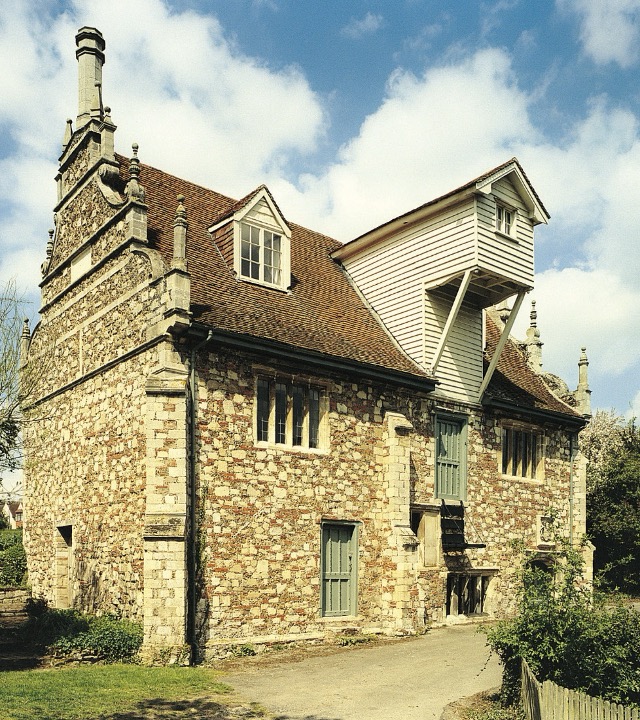
Bourne Mill, Colchester
Many smaller buildings effectively became redundant, including parish guildhalls, although some, such as Finchingfield’s, continue to operate as community buildings. New institutions were founded to replace facilities previously associated with monasteries and chantries, notably almshouses (such as at Ingatestone, Felsted and St Mark’s College at Audley End) and schools, such as Felsted, Brentwood and King Edward VI’s grammar school at Chelmsford. In the 19th century many schools were refounded, but built in the Elizabethan or Tudor Gothic style. An example is the Royal Grammar School at Colchester (1852–3). Many almshouses were also rebuilt in the 19th century in a neo-16th style.
The Reformation had resulted in the alteration of church interiors almost beyond recognition, with removal of rood screens, statues, stained glass and wall paintings, some of which have been restored in more recent times. And without the Reformation there would have been no Nonconformist chapels. On the other hand, some of the newly rich in the later 16th century were building their great houses influenced by the latest fashions from the Continent, indicating that foreign influence continued in spite of the religious separation from Roman Catholic Europe.
But it is also true to say that so great was the enduring influence of the Reformation on our architectural heritage that many buildings continued to be designed in the style of the mid–16th century for the following 400 years.
We’re delighted to announce the publication of our latest short-form volume, which was launched at the Civic Centre in Southend on Friday 11th April. In this blog, editor Ken Crowe introduces the book.
With so many histories of Southend having been produced over the years, and many still in print, the aim of the VCH Southend volunteer team to produce a ‘new’ history of Southend. Using primary sources, we present an account of the town and resort’s history that had not been told before. In part this was helped by the varied backgrounds and interests of the contributors (Jenny Butler, Ed Simpson, Judith Williams, Ian Yearsley and Ken Crowe), and in part by the VCH format. We felt, however, given the constraints of space, and in order to do justice to the account we wished to present, it would not be appropriate to follow that format throughout.
The scene is set in the Introduction, with background on local government, landscape, transport and communications and population; there is a specific section on the estates of the Scratton family who, as lords of the manor and major landowners, were key to the development of town and resort from the late Georgian to the end of the Victorian periods. An account of the historic parishes that make up the town, and the story of landownership from the mid–16th century onwards provide essential background to the development of the town and resort in the Victorian period and into the early years of the twentieth century.
The story of the development of the town’s housing estates – starting with Cliff Town – feature the part played by the major landowners, developers and speculators, who were responsible for the building of much of Southend, Westcliff, Leigh and Southchurch, and whose names are familiar to many –Scratton, Dowsett, Ramuz, Ingram, Burges. The role of transport – train links to London and, locally, trams, not only played a key role in the development and expansion of the town, but also enabled East End ‘trippers’ and others from the metropolis to spend a day or more at their nearest seaside resort. Many of these would make the town their home, and some would be among the town’s first commuters. Others, from various parts of the country, and even from Europe, would establish businesses in the town.
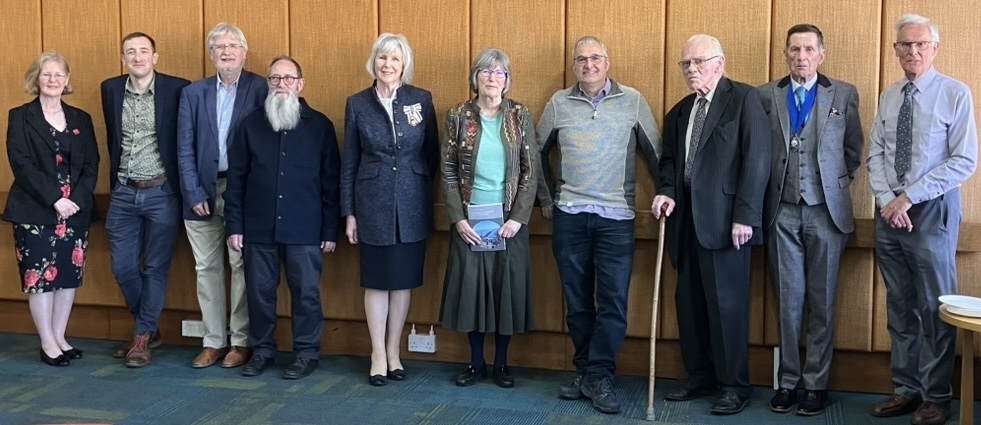
VCH volunteer contributors with trustees and supporters at the 11th April launch in Southend (L to R: Judith Williams, Adam Chapman (VCH Central Office), Chris Thornton, Ed Simpson, Mrs Jennifer Tolhurst (Lord Lieutenant), Jenny Butler, Ian Yearsley, Lord Petre, Cllr Nigel Folkard, (Deputy Mayor) and Ken Crowe)
Associated with the physical expansion of the town and resort was the establishment and growth of the financial and other business, professional and retail sectors together with the various trades and industries which supported them. Accommodating and catering for visitors (hotels and lodging houses) provided at first largely seasonal income for many residents while the expansion of the numbers building societies and banks, together with associated professions, such as land and estate agents, are all linked to the growing town and the needs of both residents and visitors. The only major industry in the area – brickmaking – was integral to the expansion of the town, and attracted the associated trades and crafts, such as bricklayers, carpenters, glaziers and plumbers, many working on a seasonal basis.
The response of the local authority and private enterprise to the needs of the growing seasonal and permanent population of the town and resort in the later Victorian period is a fascinating aspect, explored in some depth in this volume. The local authority purchased and redeveloped the pier, improved the main seafront road, laid out the cliffs and developed the esplanades and invested in a major tram system. Private enterprise was responsible for the provision of seaside amusements and the establishment of the wealth of clubs and societies that flourished here throughout the later Victorian and into the Edwardian eras. The ambition of the local authority to attract a ‘better class of excursionist’ and confine the tripper to the east side of the seafront determined the character of the resort (and the town) that is still evident to an extent today.
Southend, Victorian Town and Resort is available to purchase from the VCH Essex Trust.
Cost per copy £16 including United Kingdom P&P from VCH Essex, c/o Essex Record, Wharf Road, Chelmsford, CM2 6YT
Cheques should be made payable to Victoria County History of Essex Trust.
Overseas purchasers please contact us for additional postage costs.
By way of introduction, a little background about the Victoria County History project.
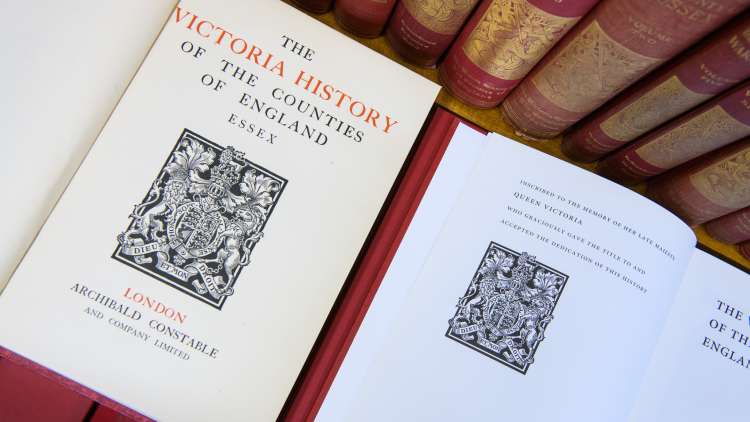
The VCH of England project was founded in the closing years of the 19th century, and originally dedicated to Queen Victoria. The aim was to research and write a history of every community within each of the counties of England. From its very inception and publication of the first volumes, the VCH ‘red books’ have gained a well-deserved international reputation for their scholarship and have become standard reference works for local historians.
Based at the Institute of Historical Research at the University of London, the central VCH office co-ordinates the work of historians working in the various counties throughout the country, and is responsible for planning the series and ensuring the highest of academic standards.
The VCH Essex Trust is the body that raises the necessary funds and commissions professional historians (our editors) to undertake the research and writing of these histories. The red book series, together with the more recent VCH ‘short’ paperback volumes, are based on original historical records, held by such institutions as The National Archives, the British Library and county record offices.
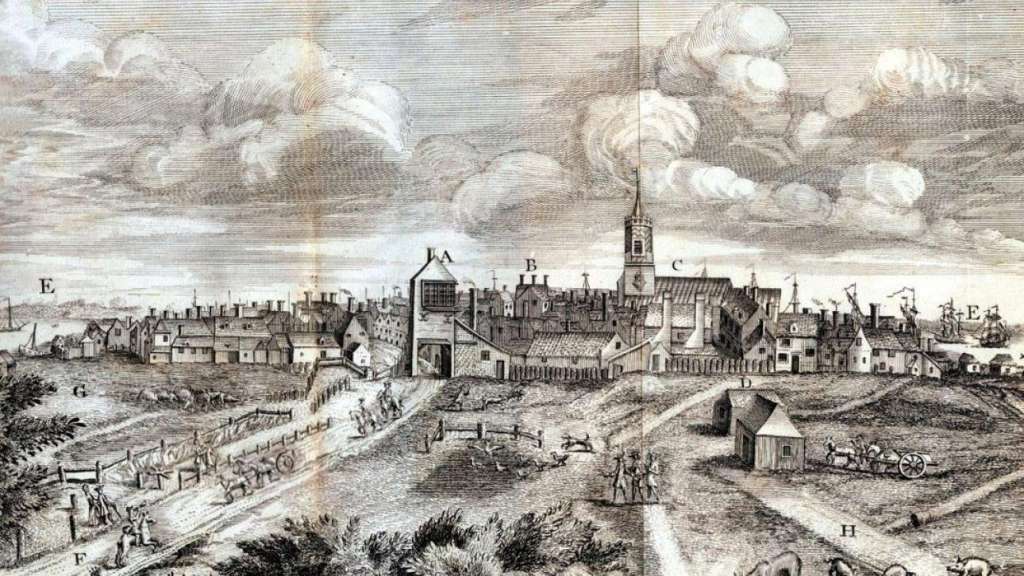
Volume I of the Essex VCH series was published in 1903, and includes a major essay on Essex Domesday, together with a complete translation. Volume II (1907) includes the standard work on the religious history of the county, including monasteries. The work then lapsed until the 1950s, a general volume on Roman Essex appearing in 1963. This was followed by volumes covering much of south-west Essex, Harlow and neighbouring parishes, the town of Colchester (Vol. IX), and the seaside resorts of Clacton, Walton and Frinton (Vol. XI). The latest published volume (XII) in this series covers St. Osyth to the Naze (Part 1, St Osyth, Clacton and Great and Little Holland; Part 2, The Soken, Kirby-le Soken, Thorpe-le-Soken and Walton-le-Soken). Volume XIII will cover the fascinating history of Harwich, from medieval times to the 20th century. In recent years the VCH launched a new series of paperback ‘Shorts’, covering individual towns or parishes. For Essex the ‘Shorts so far published are: Newport, by Anthony Tuck and others (2015) and Harwich, Dovercourt and Parkeston in the 19th century, by Andrew Senter (2019). Soon to be published is Southend, Victorian Town and Resort, by Ken Crowe and others.





 Victoria County History of Essex