To mark the upload of a draft chapter on Harwich 1919-1939, VCH Essex researcher Dr Andrew Senter has written a post about the growth of motor traffic, and attempts to accommodate it, as Harwich and Dovercourt went through a period of considerable modernisation between the wars.
The increased use of the roads by private motor vehicles was notable from the early 1920s and accordingly the police were required to attend to traffic offences mainly involving speeding. In 1920 Harwich Borough Council resolved to apply for an order to restrict the speed limit for charabancs and ‘heavy’ motor cars to six miles per hour at a time when the national speed limit was 20 mph. An especially dangerous section of road was the junction of Garland Road and Parkeston Main Road (officially renamed Station Road in 1931) in Parkeston, which was the responsibility of Essex County Council. A sign had to be erected, probably in the mid 1920s, but this did not appear to deter speeding. The borough’s first road census was conducted in 1925 as the council became concerned about the volume of traffic. Various road-widening programmes were carried out at around this time especially along Main Road in Dovercourt.
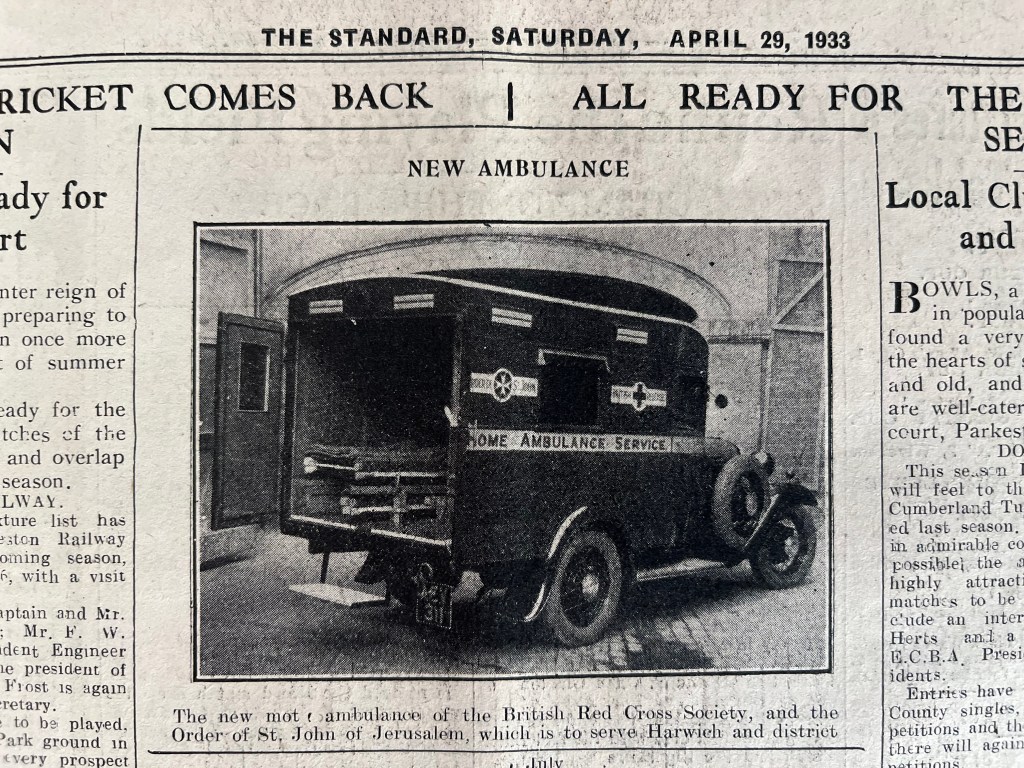
The transition from horse-drawn vehicles to mainly motorised transport was evident among commercial and public service vehicles. For example, the local Co-operative Society bought several vans and lorries in the interwar period including in 1931 a lorry to replace the horses previously used on its coal rounds. From 1921 refuse collection in Harwich borough was carried out by an electric vehicle which replaced the horses and carts. The local fire brigade bought a new motorised fire engine in 1925 leading to the selling of the horses and equipment used with the previous steam engine. The council had use of the British Red Cross Society motor ambulance based in Dovercourt in the interwar period; in 1932 it granted £100 to the society towards the cost of a new one. The council’s own horse-drawn ambulance was only finally destroyed in 1938.
The provision of public transport increased greatly in this period. The first buses commenced running to and from Colchester in 1921. Other local services were provided by charabancs, motor buses, taxis known as hackney carriages and still in 1924 three horse-drawn vehicles. In 1927 the Silver Queen Motor Omnibus Co. was granted a monopoly on local bus services and the National Omnibus & Transport Co. Ltd (both companies were subsequently absorbed into the Eastern National Omnibus Co. Ltd) was licensed to extend the Colchester-Harwich service to all year round. Dovercourt’s longest-established business, now known as Starlings Taxis, was started by Robert H. Starling by 1877 and continued by his son George E. Starling. In the 1920s they ran charabancs and taxis, with the company becoming G. E. Starling and Sons after 1928 when George’s sons Robert and Oliver continued the business.
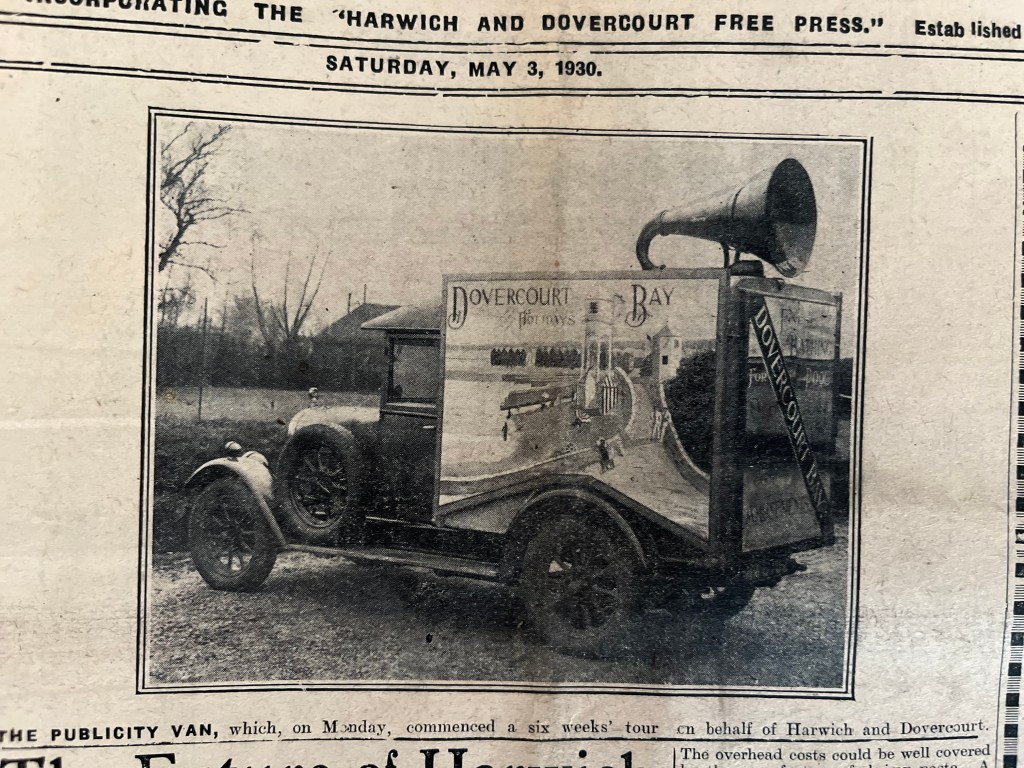
The 1930s saw much wider areas covered by public transport: in 1930 George Ewer & Co. Ltd inaugurated a bus service between London and Harwich. Dovercourt’s role as a seaside resort led to greatly increased advertising. The publicity van belonging to the local MP, John Pybus, toured the eastern region in both 1930 and 1931. The tour appears to have been successful as bus excursions ran from Wickham Market two years later. Attracting visitors from the Midlands was later adopted as a policy by the council resulting in Allenways Ltd, of Birmingham running a coach service to Harwich, Dovercourt and Parkeston in 1937. In the same year licences were also granted to the Eastern National Omnibus Co. Ltd by the Traffic Commissioners for the Eastern Area to run two new coach services from Bedford and Luton to Dovercourt.
A free public car park was opened in late 1937 in Station Road, Dovercourt, apparently on land that had been purchased by the council in late 1935 or early 1936. Dovercourt became increasingly congested by the mid 1930s. Traffic lights were installed at the junction of High Street and Kingsway in 1937. Increased road traffic in general can be seen in the census carried out during the holiday season in August 1938. In a one-week period 35,345 vehicles passed along Main Road at All Saints’ church, Upper Dovercourt, representing a significant increase on the 1935 figure (31,143).
 Victoria County History of Essex