In this blog, Herbert Eiden uncovers the tricky relations between William Innes and his parishioners in Harwich.
Shortly after Thomas Drax, the incumbent vicar of Dovercourt cum Harwich, died in January 1619, the bishop of London presented William Innes on 18th March 1619 as perpetual vicar to the parish. Since the dissolution of Colne Priory, the advowson (the right to nominate a cleric to a vacant benefice) for All Saints, Dovercourt, and the chapel of St Nicholas in Harwich rested with the crown. We do not know if James I took a personal interest in the appointment of Innes or if he delegated this task to the bishop. We also do not know where William Innes came from and where he conducted his studies. Although he is listed in the bishop’s register as having a MA (Magister Artium) his name cannot be found in the alumni registers of Oxford or Cambridge.
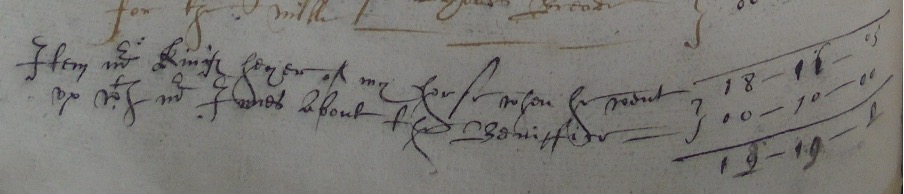
Innes is mentioned for the first time in Harwich records in a list of churchwarden expenses for the year 1618: William King, who was mayor of Harwich the previous year, claimed 10s for horse hire “when he went up with Mr Innes for the benefice”. [Church Book, Harwich Town Archive 98/1, f. 280v]. It is the final entry for the year and given that the year in England began on Lady Day (25th March) the expenses occurred probably in February or early March 1619.
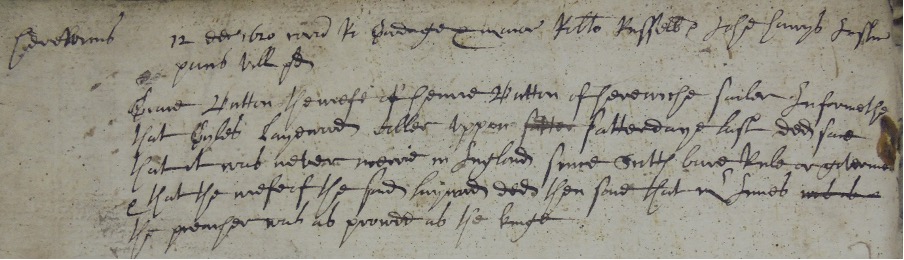
Only a short while into his incumbency, a court case reveals Innes’ unpopularity with some of his parishioners. The Court of Pleas, the lowest court in Harwich which dealt with minor suits of debt, theft, trespass, slander and other petty offences, heard on the 12th December 1620 from Grace Button, wife of Henry Button, sailor, “that Giles Haywood, cobbler, upon Saturday last did say that it was never merry in England since Scots bare rule or governed and that the wife of the said Haywood did then say that Mr Innes, the preacher, was as proud as the king” [Court of Pleas, HTA 98/2 f.182v; spelling modernised].
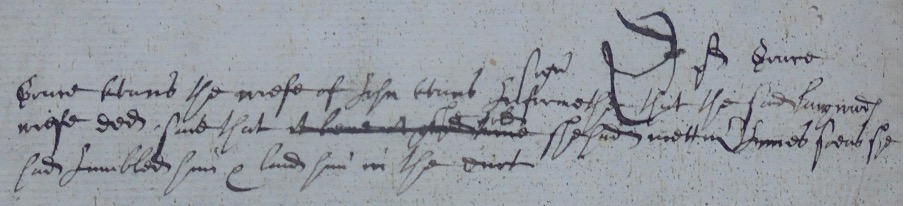
A second witness, Grace Evans, wife of John Evans, testified that “the said Haywood’s wife did say that she had met Mr Innes; says she had humbled him and had him in the dirt”.
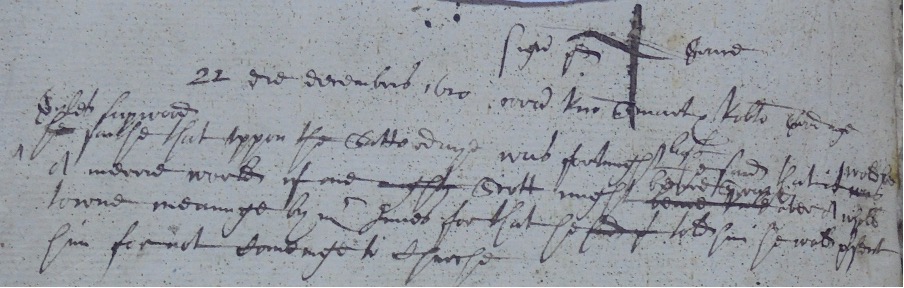
Finally, ten days later Giles Haywood confirmed that he spoken to the vicar “on Saturday a fortnight ago” and that he said “it would be a merry world if one Scot might become sovereign over an English town, meaning by Mr Innes for that he told him he would present him for not coming to church”.
Although the meaning of these three statements is not entirely clear it seems Grace Button alleged that Giles Haywood had insulted the king by declaring that the times of ‘Merry England’ were over since James I, a Scot, had come to the throne, and that Haywood’s wife then doubled down and called the vicar as haughty and arrogant (‘proud’) as the king. Less detail about what was said is given by the second witness, Grace Evans, but she seems to corroborate that Haywood’s wife humiliated Mr Innes.
Haywood’s deposition gives a different slant to the story when he, probably sarcastically, commented on the occasion of meeting the vicar that it must be a joyful world if a Scot became the ruler of an English town. This was directed at Mr Innes, because the vicar had notified him that he would report him for not attending church. In this reading the insult is not explicitly directed against the king. Instead, it implies that William Innes was Scottish and Haywood’s derogatory remark was an ethnic slur, which, however, was also a dig at the king.
The toponymic surname ‘Innes’ originates from Moray in Scotland. Confirmation of his Scottish origins comes from Burke’s Peerage which lists William as one of seven sons of the Alexander Innes of Cotts and Leuchars who was the bailiff of Spynie. His royalist family background probably explains his presentation to Dovercourt cum Harwich vicarage. It also might explain why he cannot be found in the Cambridge and Oxford registers because he quite likely had a degree from a Scottish university.
Unfortunately, nothing is known about the outcome of the case. However, William Innes and his Harwich parishioners – he seems to have been getting on with his congregation in Dovercourt – were at loggerheads on several occasions during the coming decade. It seems likely that a naval and mercantile town, in close relationship with the Low Countries would have been more Puritan in outlook than the neighbouring rural parish. Innes quarrels with Harwich Puritans culminated in a case before the supreme ecclesiastical Court of High Commission in 1629–1631, in which even the king got involved at one stage. But this is something you will have to wait to read in the Harwich and Dovercourt Red Book.
 Victoria County History of Essex