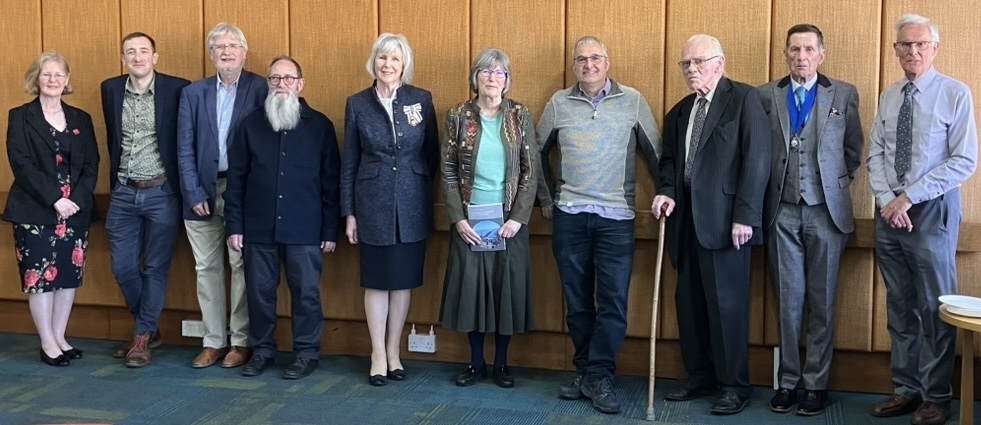
We’re delighted to announce the publication of our latest short-form volume, which was launched at the Civic Centre in Southend on Friday 11th April. In this blog, editor Ken Crowe introduces the book.

With so many histories of Southend having been produced over the years, and many still in print, the aim of the VCH Southend volunteer team to produce a ‘new’ history of Southend. Using primary sources, we present an account of the town and resort’s history that had not been told before. In part this was helped by the varied backgrounds and interests of the contributors (Jenny Butler, Ed Simpson, Judith Williams, Ian Yearsley and Ken Crowe), and in part by the VCH format. We felt, however, given the constraints of space, and in order to do justice to the account we wished to present, it would not be appropriate to follow that format throughout.
The scene is set in the Introduction, with background on local government, landscape, transport and communications and population; there is a specific section on the estates of the Scratton family who, as lords of the manor and major landowners, were key to the development of town and resort from the late Georgian to the end of the Victorian periods. An account of the historic parishes that make up the town, and the story of landownership from the mid–16th century onwards provide essential background to the development of the town and resort in the Victorian period and into the early years of the twentieth century.
The story of the development of the town’s housing estates – starting with Cliff Town – feature the part played by the major landowners, developers and speculators, who were responsible for the building of much of Southend, Westcliff, Leigh and Southchurch, and whose names are familiar to many –Scratton, Dowsett, Ramuz, Ingram, Burges. The role of transport – train links to London and, locally, trams, not only played a key role in the development and expansion of the town, but also enabled East End ‘trippers’ and others from the metropolis to spend a day or more at their nearest seaside resort. Many of these would make the town their home, and some would be among the town’s first commuters. Others, from various parts of the country, and even from Europe, would establish businesses in the town.
Associated with the physical expansion of the town and resort was the establishment and growth of the financial and other business, professional and retail sectors together with the various trades and industries which supported them. Accommodating and catering for visitors (hotels and lodging houses) provided at first largely seasonal income for many residents while the expansion of the numbers building societies and banks, together with associated professions, such as land and estate agents, are all linked to the growing town and the needs of both residents and visitors. The only major industry in the area – brickmaking – was integral to the expansion of the town, and attracted the associated trades and crafts, such as bricklayers, carpenters, glaziers and plumbers, many working on a seasonal basis.
The response of the local authority and private enterprise to the needs of the growing seasonal and permanent population of the town and resort in the later Victorian period is a fascinating aspect, explored in some depth in this volume. The local authority purchased and redeveloped the pier, improved the main seafront road, laid out the cliffs and developed the esplanades and invested in a major tram system. Private enterprise was responsible for the provision of seaside amusements and the establishment of the wealth of clubs and societies that flourished here throughout the later Victorian and into the Edwardian eras. The ambition of the local authority to attract a ‘better class of excursionist’ and confine the tripper to the east side of the seafront determined the character of the resort (and the town) that is still evident to an extent today.
Southend, Victorian Town and Resort is available to purchase from the VCH Essex Trust.
Cost per copy £16 including United Kingdom P&P from VCH Essex, c/o Essex Record, Wharf Road, Chelmsford, CM2 6YT
Cheques should be made payable to Victoria County History of Essex Trust.
Overseas purchasers please contact us for additional postage costs.
 Victoria County History of Essex